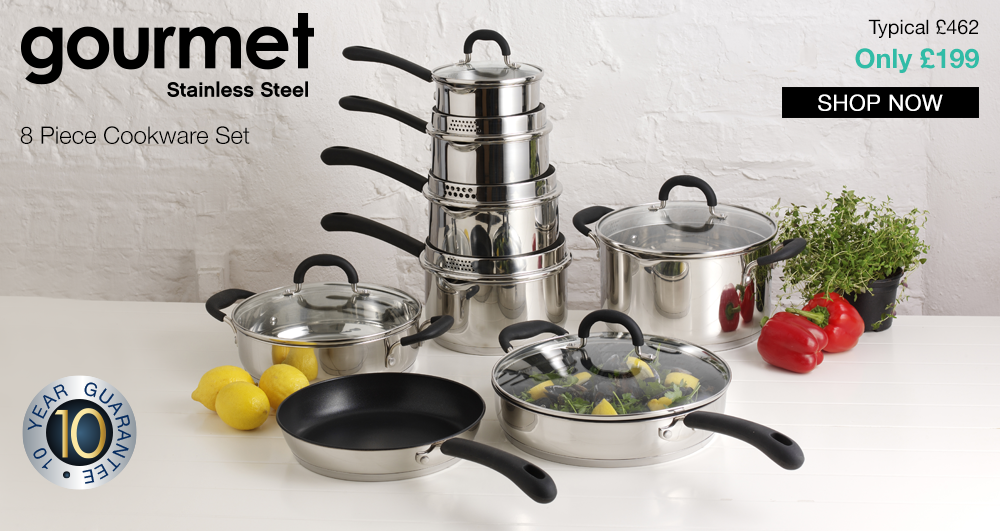
ProCook Gourmet Steel

Featuring our own ProCook Ultra non-stick cookware coating, and induction compatible, our Gourmet Steel range is crafted from 18/10 highest quality stainless steel to our own stringent specifications, Gourmet Steel offers incredible, versatile cookware at amazingly low prices.

ProCook Professional Steel

Our Professional Steel induction cookware benefit from superb 5 Star ProCook Ultra Plus triple layer non-stick coatings combined with the exceptional even heat distribution generated from commercial quality, 7mm impact bonded bases, making them suitable for cooking anything from omelettes and low fat stir fry dishes to bumper family breakfasts without worry of sticking or burning.

Tuesday, 10 May 2016

Going Gourmet At Home With Cookware Sets

If you have ever whipped up a meal that left you underwhelmed or, worse, calling for a pizza, you may have been left wondering what went wrong, especially if you were following a recipe.

They say bad workmen blame their tools but, with good gourmet cooking, if you don’t have the right equipment then you will struggle to produce the impressive meals that you see on TV. 

You may have been put off by the sheer variety in cookware sets; questioning why you need so many pots and pans, but there is a reason so many different pieces exist. They serve a precise purpose and are made to produce specific foods perfectly. You can’t just stick everything in one pot and hope for the best if you want to produce something special.

Each piece that you see in cookware sets is unique and will cook in a different way, meaning some foods just will not cook well in certain pans. Cooking a soup or producing a stock in a wok, for example, will never get you good results because of the shape and design. 

A wok is designed for quick, nimble frying and will do a poor job for low simmering foods because the heat will not distribute evenly. Similarly, a large, basic sauce pan is, despite the name, a poor choice for cooking sauces and gravies. Instead, a saucier pan is shaped for better temperature control and easier liquid evaporation, making it a much better choice for creating the perfect sauce.

As important as the different designs are,consider the different materials used to make the best cookware sets. Whilst your simple pan will probably be made from stainless steel, cookware sets may be made from copper, cast iron, aluminium or a mix of these different materials. 

This range of choice lets you have better heat convection for quicker, even cooking, and will be less reactive with the food, protecting the flavours. This all plays an important role in producing gourmet food, as opposed to the simple, one-pot meals from your student days, and makes choosing the right cookware set an important task if you want perfect meals.

Good cooking is a source of pride for many of us and nothing is more disappointing than a bland or unsavoury meal. Don’t let poor equipment affect your cooking: take the plunge on a good cookware set to give yourself the best chance of serving up a meal that will put a smile on everyone’s face.

Tuesday, 19 April 2016

The Origins of The Oven Casserole

As you might expect, the traditional casserole dish has a long and rich history. Since the Stone Age it has been known that slowly cooking food brings out extra flavor and earthenware pots count among some of the earliest cooking implements to have been used by humans. But what about the specific notion of an oven casserole? Here's a brief history of the popular dish, along with a recipe that will help you make use of any leftovers.

The first modern cooking ranges began to appear in England the late 1700s. These were essentially a case of mortar or cast iron that enclosed a fireplace with a restricted chimney. These made it possible to cook on either the stove top or in oven compartments. However, the heat wasn't really adjustable, and the whole appliance had to be heated in order for it to work, so the idea of putting a pot in the oven would have seemed a little odd - the stove would have been hot anyway. However, poorer families were making use of a kind of oven casserole at this time. It was known as a box oven stew, and involved heating a pot over a fire to start the cooking process, then quickly moving it to a box and covering it with lots of straw. This kept the pot hot for hours, and created a slow cook without requiring any extra fuel. 

The name casserole appeared as a term for a French dish that involved mashed rice and bits of meat in the 1800s, but in the later part of that century it began to apply to oven casseroles in America. These grew in popularity during the depression, when Campbell’s released special condensed soups marketed for the purpose of casserole cooking. As with most American classics, putting a new name on an old idea was enough to cement it as part of the national culinary identity. 

Leftover turkey casserole recipe:

500g turkey, shredded
300g vegetables
1 onion, diced
1 eating apple, cored and chopped
2 tbsp plain flour
300ml vegetable or chicken stock
A dash of vinegar
A sprig of thyme
1 tbsp wholegrain mustard
2 tbsp runny honey


1. Fry the onions and apple in a casserole pot with a dash of vinegar until softened. Stir in the flour.
2. Add the stock gradually and stir, followed by the rest of the ingredients.
3. Move the casserole to the oven, heated to 190°C / gas mark 5.
4. Remove after 30 - 45 minutes, remove sprig of thyme, and serve with crusty bread.

Wednesday, 13 April 2016

Hold Your Knife Like A Chef

You may have just bought yourself a set of shiny, professional chef’s knives, but what good is such a knife if you do not know how to use it properly? The chefs you see on TV or at your favourite restaurant can cut at a rapid pace and you will, no doubt, have dreams of being that quick with your chopping. 

With practice, you can definitely match the experts at quick, even cutting, but every skill starts with the basics; in this case, holding the knife properly. You may think there is nothing to it - just hold the handle and cut with the blade – but, as any chef will tell you, the hammer-like grip most amateurs use is not good enough. It offers little control over the blade and makes professional cutting techniques uncomfortable and awkward.

So, let’s look at the proper way to hold a chef’s knife. First, it is important to grip in the right place. Rather than clamping around the handle you should, instead, pinch the blade at the base, by the handle, with your thumb and index finger. By gripping at this point, your control on the blade is much greater and it allows for much easier movement of the wrist as you cut. This will be important when tackling the rolling technique used in good, efficient cutting.

The rest of your hand should then loosely curl around the handle with your middle finger resting right against the back end of the blade, called the bolster. Some may find it easier to use the middle finger along with the index to pinch the blade, which works just as well. If you choose to do this, your ring finger should rest against the bolster instead. This will keep the knife steady whilst keeping your grip flexible, allowing you to manipulate your chef’s knife easily. 

Contrary to what many say, you should not place your index finger along the top of your chef’s knives as this offers no control and will, more likely, cause the blade to be unsteady and unsafe. A secure grip at the base of the bladewill provide a solid, controlled cut every time.

This grip may seem odd at first, but with regular practice it will quickly feel natural and the results will be much smoother and more comfortable when cutting with your chef’s knives. With this grip mastered, you will soon be on the way to professional chopping when you cook.